
INGECOM Unveils Its 5 Euro Active RFID Tags
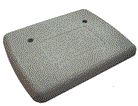
INGECOM, a world leader in the field of active RFID tags and controllers, recently announced its 2nd generation of ActiveRFID tags and controllers that represent a breakthrough in terms of performance- to-cost-ratio, far away from PowerPoint slides and future promises. These new ActiveRFID tags, in the size of half a credit card, are targeted at high volume markets with a unit price of 5 euros.
This achievement is made less then two years after having sold the technology of its 1st generation of ActiveRFID tags to Siemens, which was already considered as a major recognition from the industry, while INGECOM maintained development and sales rights.
This 2nd generation of ActiveRFID tags is built on a new ASIC, contains a completely new proprietary communication protocol between the tag and the controller and is covered by two new patents from INGECOM. However the compliance with the 1st generation remains at the software interface level in order to protect prior investments.
With a battery lifetime of 10 years and a ping rate of 2 seconds, this new tag offers a fully automatic, permanent and real-time inventory or tracking functionality for less than 0.005 euro per day of usage. The infrastructure cost and the Edgeware license is already included in this price. The operating temperature ranges from -20°C up to +70°C without impacting the battery lifetime.
The reading distance is over 200m outdoors, and could reach typically 30-50m in a warehouse environment. This range can be increased with the additional range expander, to cover an impressive radius of 500m, or 80 hectares (200 acres!). The tag addresses read on metal conditions, thus making it a very attractive proposition when the assets are metal roll cages, blade servers and other high value items in a data center. The anticollision rate exceeds 10'000 tags per minute per reader. The dense reader mode is inherent to the system, without the requirement for any smart synchronization mechanism and hence keeping the infrastructure cost low. This very high anticollision rate enables large warehouse management applications.
The plastic shell of the tag is water-resistant, half a credit card size, only 4mm thick, and is fitted with two holes in case the user needs to bolt the tag on the asset. It can be delivered with optional UV resistant material for outdoor use, or optional plastic resistant to chemicals like alcohol, petrol, or acetone. With this option the tag has been tested and remains operational after 36h spent in an acetone bath, without any visible degradation on the surface of the case.
The ActiveRFID tag is developed and built with local components, indicating that through patented manufacturing assembly methods active tags can be produced effectively in Switzerland.
"Moore's law also applies to active RFID tags, as the 2nd generation of ActiveRFID tags is more cost effective, smaller and totally outperforms the 1st generation of active tags", says Olivier Desjeux, CEO of INGECOM. "Beating this ratio is today really a challenge, but we're already thinking of different ways to do it. In any case the launch of the 2nd generation establishes INGECOM as one of the worlds leading active RFID tag manufacturers. Today the price of our ActiveRFID tags is lower than high-end passive tags, while offering higher performance and eliminating the need to re-engineer the process before introducing passive RFID to suit the portal architecture inherent to this technology."
A key performance indicator of this 2nd generation of ActiveRFID tags is the power consumption of 500nA in standby-mode and 12mA in transmit mode. A typical WiFi tag consumes at least forty to fifty times more energy. "No need to mention that, with such an interesting power budget, a motion sensor to detect when to activate the tag would only add costs to the tag. We optimize the tag for the function only, that's the trick, and we've patented the design, of course." says Olivier Desjeux.
The compliance to standards is also taken into account during the development. The tag comes with an optional EPC 96 bit ID structure. The Edgeware interface is compliant with the RTLS ISO24730-1 standard. This tag could meet the EPC Class 4 standard, when released by EPC-Global.
The tag addresses several target markets, such as reusable containers, including plastic pallets, totes, crates, or metal pallets. Up to now reusable pallets are featuring two ruggedized and expensive passive tags that need to match the lifetime of the pallet, typically 7 to 10 years. Those passive tags require either a manual scanning process, which intrinsically affects significantly the error rate, introduces undesired labor costs and requires a general process re-engineering, or an automatic reading process with expensive dock door installations, typically in the range of 10'000 euros per door. In the case of the ActiveRFID tags provided by INGECOM, the lifetime of the tag is identical to the lifetime of the tagged asset, only one ruggedized tag needs to be used and the tag can be fully embedded and thus hidden inside a typical plastic pallet and as a consequence limiting the risk of causing damage to the tag. With this configuration the ActiveRFID tag will automatically provide its ID to a neighboring controller in real-time within 30-50m distance. The low cost controller (below 400 euros, all inclusive) is then simply interfaced to the customers' ERP system via Edgeware. Large savings on the operational costs are expected as the system performs its mission very discretely, permanently, automatically and in real-time.
Louis Bianchin, (Venture Development Corporation, VDC) indicates that "In the RFID world companies sometimes make revenue projections which are hard to deliver upon. In the case of INGECOM it's different. The company has been already in business since almost four years, is profitable and successful, and they are pitching to the market a real product that is really industrialized. It is encouraging to see a breakthrough happening so fast. This new ActiveRFID tag from INGECOM will contribute significantly to the growth of this segment. With such a product a portion of the asset management segment, initially looking at the semi-active RFID technology could revert back to active tags. With such a cost-effective product available on the market today, large users can address closed- loop automatic asset management applications easily.
Samples of INGECOMs 2nd generation of ActiveRFID tags and controllers are available immediately. The production is expected to start in April this year and orders can already be placed from now on. The delivery will be made with unbranded products.
About INGECOM
INGECOM is designing and producing a whole range of active RFID tags. The original concept of those new RFID products brings a breakthrough in the cost-to-performance-ratio. The Swiss company has proven to be successful on different markets, ranging from the supply chain management, all the way to people tracking in hospitals. The innovation is driving this company for which low power is not simply a marketing catch.
For additional information, please contact: Olivier Desjeux, CEO INGECOM Switzerland http://www.ingecom.ch/
SOURCE: INGECOM